
CHRONIC DIARRHEA
CHRONIC LOOSE STOOLS AND COMMON CAUSES
Giardia
Giardia (giardiasis)
Malabsorption
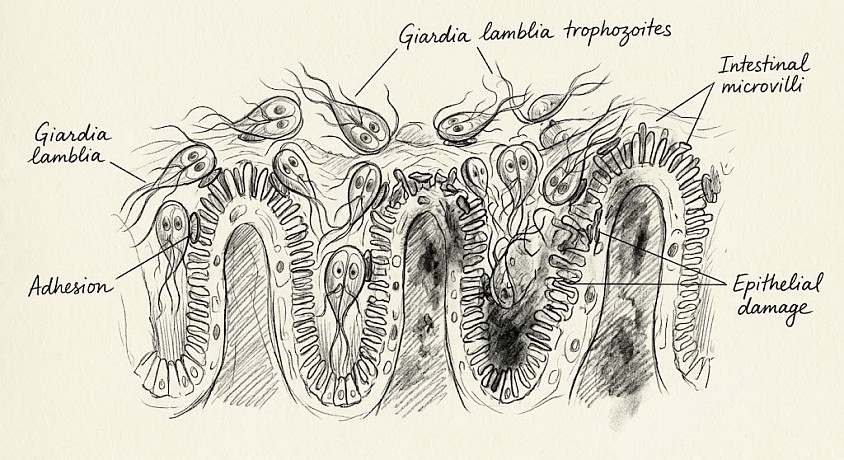
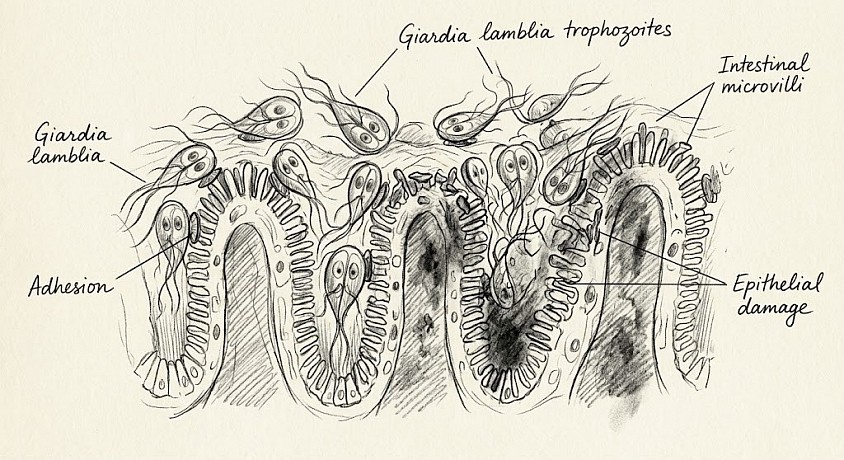
Giardia significantly impairs nutrient absorption and commonly causes secondary lactose intolerance. The parasite attaches to the small intestinal mucosa without invading cells, disrupting brush border enzyme function and epithelial integrity, leading to malabsorption of carbohydrates, fats, fat-soluble vitamins, and micronutrients 1 2.
Mechanism of nutrient malabsorption
- Brush border damage: Giardia trophozoites attach to enterocytes and disrupt microvilli, reducing surface area for absorption.
- Enzyme downregulation: The parasite induces lactase deficiency by damaging the lactase-containing brush border; lactase is situated at villous tips and is particularly vulnerable to injury from infectious enteritis 1 3.
- Epithelial barrier dysfunction: Giardia stabilizes HIF-1α in intestinal epithelial cells, altering glycolytic metabolism and compromising tight junction integrity, which increases intestinal permeability 2.
- Malabsorption profile: Chronic infection causes deficiencies in vitamin A, B₁₂, folate, and fat-soluble vitamins, with steatorrhea and weight loss 1.
Post-Giardia lactose intolerance
- Incidence: Secondary lactose intolerance develops in 20–40% of patients following Giardia infection and may persist for several weeks 4.
- Pathophysiology: Infectious enteritis damages lactase-containing enterocytes; new immature enterocytes are lactase-deficient, resulting in transient hypolactasia 3.
- Clinical impact: Undigested lactose reaches the colon, where bacterial fermentation produces hydrogen, carbon dioxide, methane, and short-chain fatty acids, causing osmotic diarrhea, bloating, flatulence, and abdominal pain 3.
- Duration: Typically resolves within 2–6 weeks after eradication of Giardia as the mucosa heals and lactase expression recovers 4.
Management considerations
- During acute infection: Temporary lactose restriction may reduce symptoms, though antimicrobial therapy to eradicate Giardia is the definitive treatment.
- Post-treatment: Reassess lactose tolerance after 4–6 weeks; most patients regain lactase function. Persistent symptoms warrant evaluation for other causes of malabsorption.
- Nutritional support: Monitor for deficiencies in vitamin B₁₂, folate, and fat-soluble vitamins (A, D, E, K) in prolonged infections; consider supplementation if indicated.
Sources:
- Effect of inoculation dose on infection kinetics and immune responses to giardia (...). Nature, 2025
- Giardia duodenalis stabilizes HIF-1α and induces glycolytic alterations in intestinal epithelial cells (...). Nature, 2025
- Update on lactose malabsorption and intolerance: pathogenesis, diagnosis and clinical management (...). BMJ, 2025
- Guidelines for the prevention and treatment of opportunistic infections in children with and exposed to HIV. Clinicalinfo.hiv.gov
